
Pinball began as a French parlor game called bagatelle, became a coin-operated American craze in 1931, got flippers in 1947, went electronic in the mid-1970s and is still built in the United States today. Each step changed how the game plays, and each one left machines that collectors still hunt for. This guide walks through the timeline in order, then shows you how to turn that history into a machine you can own.
TL;DR
- Pinball descends from 18th-century French bagatelle. The coin-operated, glass-covered game arrived in the United States in 1931.
- Battery-powered bells and kickers came in 1933. Player-controlled flippers came in 1947 and turned pinball into a game of skill.
- The first microprocessor-powered machine appeared in 1975, and New York City lifted its pinball ban in 1976.
- Stern Pinball and Spooky Pinball carry the tradition forward with new machines built in the Midwest.
- Knowing the eras makes it easier to choose between a new machine and a used one.
Table of Contents
- Where pinball came from: bagatelle
- 1931: the coin-operated game is born
- 1933: batteries, bells and kickers
- 1947: flippers change everything
- The ban years and Roger Sharpe
- The mid-1970s: solid-state electronics
- Stern Pinball: a Chicago name still building
- Spooky Pinball: a newer American maker
- A quick timeline
- What the history means if you want to own a machine
- Browse machines from the eras you just read about
- FAQ
- Sources
Where pinball came from: bagatelle
Pinball traces its roots to bagatelle, an 18th-century French game, according to The Strong National Museum of Play. Players shot balls across a board studded with pins and cups. It was a tabletop pastime, not something you fed coins into.
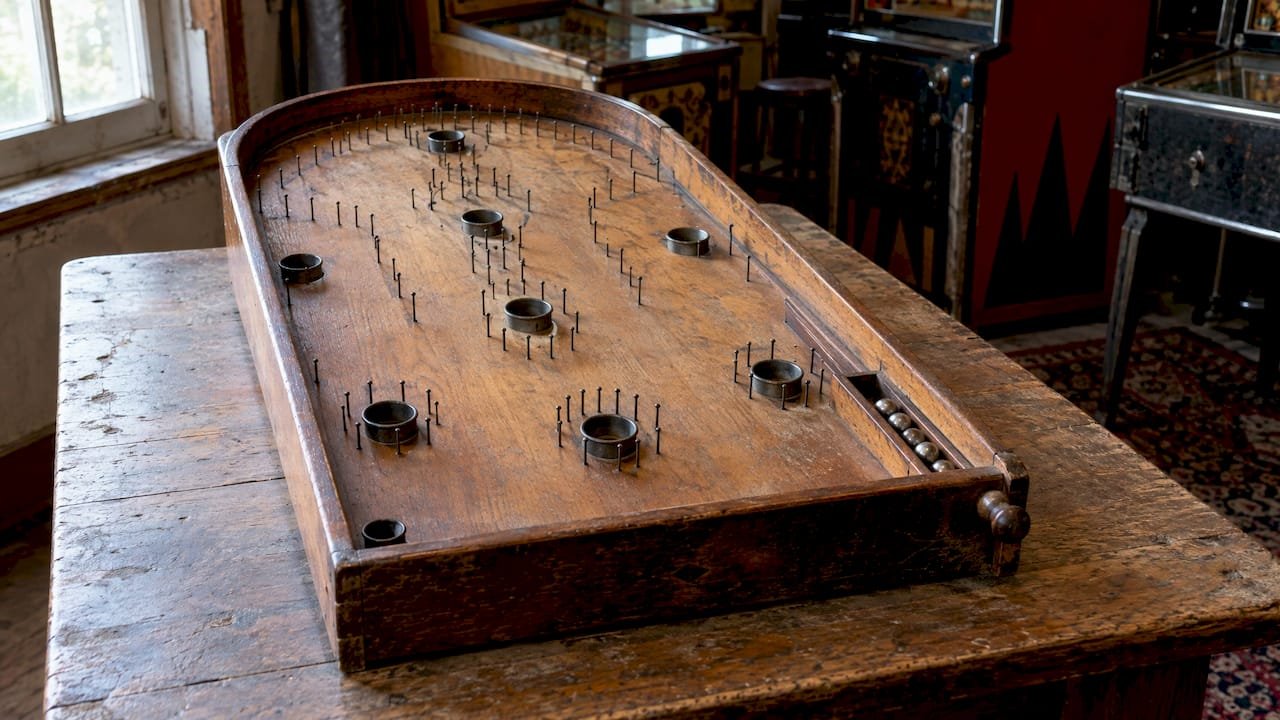
The same source records that in 1870 Montague Redgrave added a spring-loaded plunger and a bell. That plunger is the ancestor of the one you pull back on a modern machine. The shift from pushing balls with a cue to launching them with a spring made the game faster and easier to repeat, which suited it to later commercial use.
That explains why you will see “pinball” and “bagatelle” used together in older histories. The bagatelle board supplied the idea: a ball, pins, scoring targets and gravity. What it lacked was the cabinet, the coin slot and the mechanics that came in the twentieth century.
1931: the coin-operated game is born
The modern coin-operated machine emerged in 1931. The Strong credits Arthur Paulin and Earl Froom with Whiffle, a coin-operated, glass-covered game, and notes that American manufacturers added glass, mechanical systems and a coin mechanism that year.
Also in 1931 came David Gottlieb’s Baffle Ball. The Strong’s Google Arts & Culture exhibit describes it as the first mass-produced, mass-marketed pinball game, and says it helped establish Chicago as the center of the industry. That Chicago connection still matters: Stern Pinball describes its headquarters as minutes from O’Hare International Airport.
Different websites date the “first” machine differently, some pointing to 1930 and some to 1931, because early games were small countertop devices and records are thin. The museum sources agree on the larger point: the early 1930s is when pinball became a coin-operated business.
The timing was no accident. One history of the period says the game took shape during the Great Depression, when Americans wanted cheap distraction. A nickel or a penny bought a few minutes of play, which is a big reason countertop games spread through shops and bars.
1933: batteries, bells and kickers
Early games were passive. You launched the balls and watched where they dropped. In 1933, Harry Williams’s Contact brought battery-powered kickers and bells. Now the machine could react: a ball hitting a bumper could push back with a jolt and a sound.
That was the beginning of the machine as a performer. The sound and motion that fill an arcade or a game room today started with those early bells. If you restore or collect early games, this is the era where “mechanical” begins to mean something close to what you recognize.
1947: flippers change everything
The next leap came in 1947. D. Gottlieb & Co.’s Humpty Dumpty added player-operated flippers, which gave players the ability to control the ball for the first time.
Before flippers, a game was largely about the launch. After them, it was about timing, positioning and decisions. A player could catch a ball, aim at a target and build a repeatable strategy. Nearly every machine made since descends from that design.
It also set up an argument that shaped the next three decades: is pinball a game of skill or a game of chance? Hold that thought, because it ends up in a New York City courtroom.
The ban years and Roger Sharpe
For decades, some American cities treated pinball as gambling. New York City had a ban of more than four decades. In 1976, the ban ended after a pro-pinball lobby led by Roger Sharpe helped demonstrate the game was one of skill, according to George Washington University’s magazine.
Sharpe has described the moment that convinced him. In an interview with Pinball Magazine, he recalled watching a player cradle a ball and aim shots, which showed him pinball involved skill.
This answers a question readers often ask, “Is pinball skill or luck?” Both are present, as in many games, but flippers made the skill side real. Someone who learns to trap the ball, pass it between flippers and shoot a target on purpose will beat a beginner over time. That is why a home machine rewards repeat play in a way many other games do not.
The mid-1970s: solid-state electronics
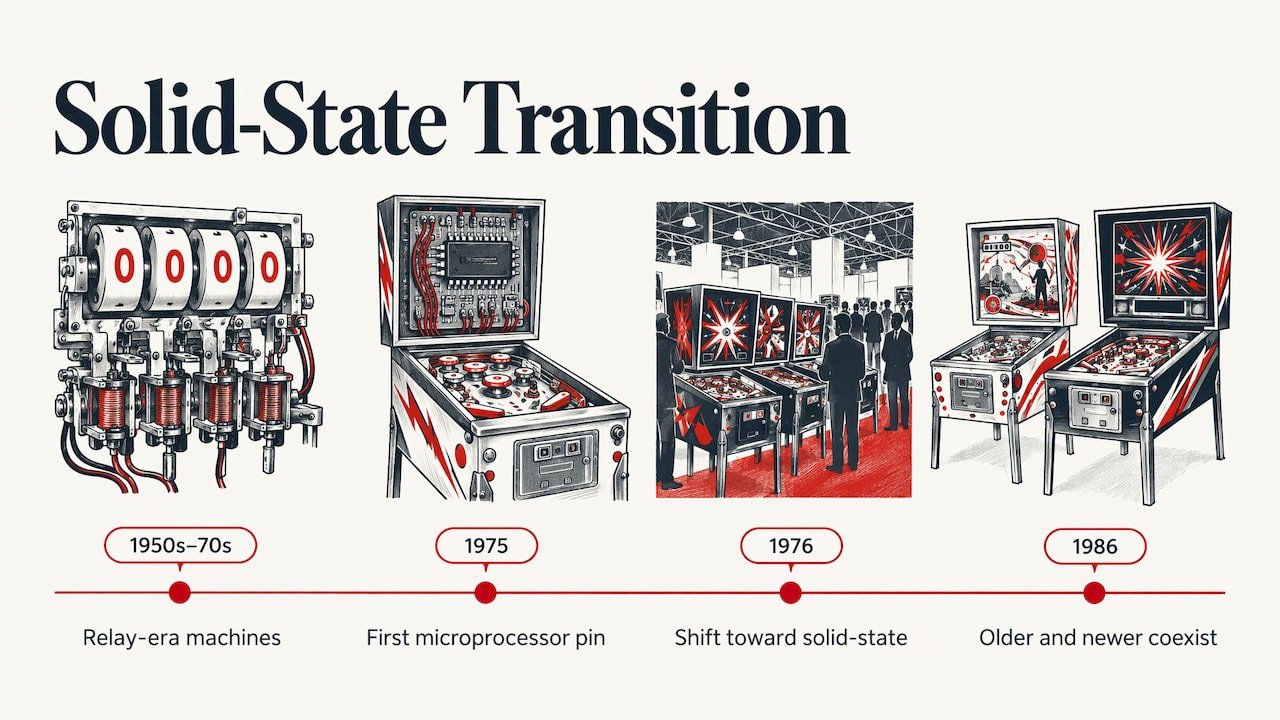
Through the 1950s, 60s and early 70s, machines ran on relays, switches and motorized score reels. That is the electromechanical era, and its machines have a distinct clatter that many players love.
The next transition began in the mid-1970s. In 1975, Mirco Games released The Spirit of ’76, the first pinball machine powered by microprocessors, and the industry moved toward making electronic games exclusively. A listing in Play Meter magazine notes that the 1976 Music Operators of America convention signaled the same transition, as operators moved from electromechanical pins toward solid-state ones.
The same Play Meter issue, published in 1986, reflects on a dual market in which operators mixed older machines with newer, higher-earning electronic games. That pattern is familiar to collectors today: older and newer machines coexist, and each has its own audience.
What solid-state meant for players
Electronics allowed more complex scoring, multiple balls, memory of what you had done in a game and eventually richer rules. The Strong’s exhibit also lists ramps, pop bumpers and interactive toys among the developments that shaped the modern game. Pinball stopped being only about keeping the ball alive and became about completing goals within a game.
Pinball and pop culture
Pinball designers have always borrowed from whatever people are watching. Smithsonian Magazine compares pinball’s popularity to modern gaming trends, noting that the design relies on adapting mass cultural phenomena to appeal to both casual and dedicated players. You can see it in today’s licensed machines: movies, bands and TV franchises supply the themes, and the game supplies the way to play inside them.
Stern Pinball: a Chicago name still building
Stern Pinball describes its lineage as going back to the early 1930s. On its about page, the company says that in 1986 Gary Stern helped found Data East Pinball, which Sega later bought and renamed Sega Pinball. Gary later bought it back and renamed it Stern Pinball, Inc.
Stern also says that in 2009 it partnered with an affiliate of Hagerty Peterson & Co. to strengthen operations and finances, expand its product offering and enter new markets. The company states that it designs, engineers, manufactures, markets and distributes pinball games, parts, accessories and merchandise around the globe.
For a buyer, the history matters in a practical way. A manufacturer with decades of continuity supports its machines with parts and accessories, so you can personalize a game with items like toppers and art blades long after you bring it home. Stern also appears in a GamesBeat interview with Gary Stern looking back on four decades in business.
Spooky Pinball: a newer American maker
Not all of pinball’s modern story comes from large factories. According to Wikipedia’s entry on the company, Charlie Emery founded Spooky Pinball in Benton, Wisconsin, in 2013. His work began with a pinball podcast and a custom Godzilla machine built on a 1983 game, which he took to the 2011 Midwest Gaming Classic.
The company’s first machine was America’s Most Haunted, a design that grew out of work by Benjamin “Ben Heck” Heckendorn. The same entry says the first production run was 150 units and took almost two years to sell. Spooky shows that a small team in a small town can still bring a new pinball machine to market.
A quick timeline
| Year | Milestone | Why it matters |
|---|---|---|
| 18th century | French bagatelle | The ball-and-pins idea |
| 1870 | Redgrave adds plunger and bell | Spring launch becomes standard |
| 1931 | Whiffle and Baffle Ball | Coin-operated pinball begins |
| 1933 | Contact adds battery-powered kickers and bells | Machines start to react |
| 1947 | Humpty Dumpty adds flippers | Players control the ball |
| 1975 | The Spirit of ’76 | First microprocessor-powered machine |
| 1976 | New York City lifts its ban | Pinball recognized as a game of skill |
| 1986 | Gary Stern helps found Data East Pinball | Start of the line that became Stern |
| 2013 | Spooky Pinball founded | A new generation of small-batch makers |
What the history means if you want to own a machine
The timeline maps neatly onto what you can buy.
- Electromechanical machines appeal to collectors who like the sound and mechanics of the pre-electronics era.
- Solid-state machines bring the first electronic scoring and rules.
- Modern machines carry licensed themes, ramps, toys and deep rule sets, and they come with current manufacturer support.
If you are buying your first machine, think about what drew you to pinball. If it was the nostalgia of an arcade, look at used machines from the era you remember. If it was a favorite movie or band, a new licensed game is a natural match. If you run a business and want an arcade attraction, a machine with instant recognition for your customers does a lot of the work.
Our perspective: why history helps you buy
We sell pinball every day, and the question we hear most from first-time buyers is where to begin. Our answer is to start with the era. Pinball’s history is really a set of design decisions, and each one gives you a different kind of game.
As an authorized dealer for Stern Pinball and Spooky Pinball, we see how much of that heritage lives in new machines. A modern Stern is the descendant of the Chicago manufacturing tradition, and a Spooky machine carries the independent spirit of a small American maker. We also work with American Pinball and handle used machines, so you can compare a new game and a pre-owned one side by side.
We built our buy, sell and trade service for collectors who know exactly what they are chasing and for families who simply want a machine that gets everyone around it. Whichever you are, our goal is to help you find a game you will still enjoy playing years from now.
the author
Browse machines from the eras you just read about
If the history made you want to play, we carry new and used machines, plus official accessories such as toppers, art blades and parts. We are an authorized dealer for Stern Pinball and Spooky Pinball, we deliver across the Lower 48, and we accept Bitcoin and other cryptocurrency.
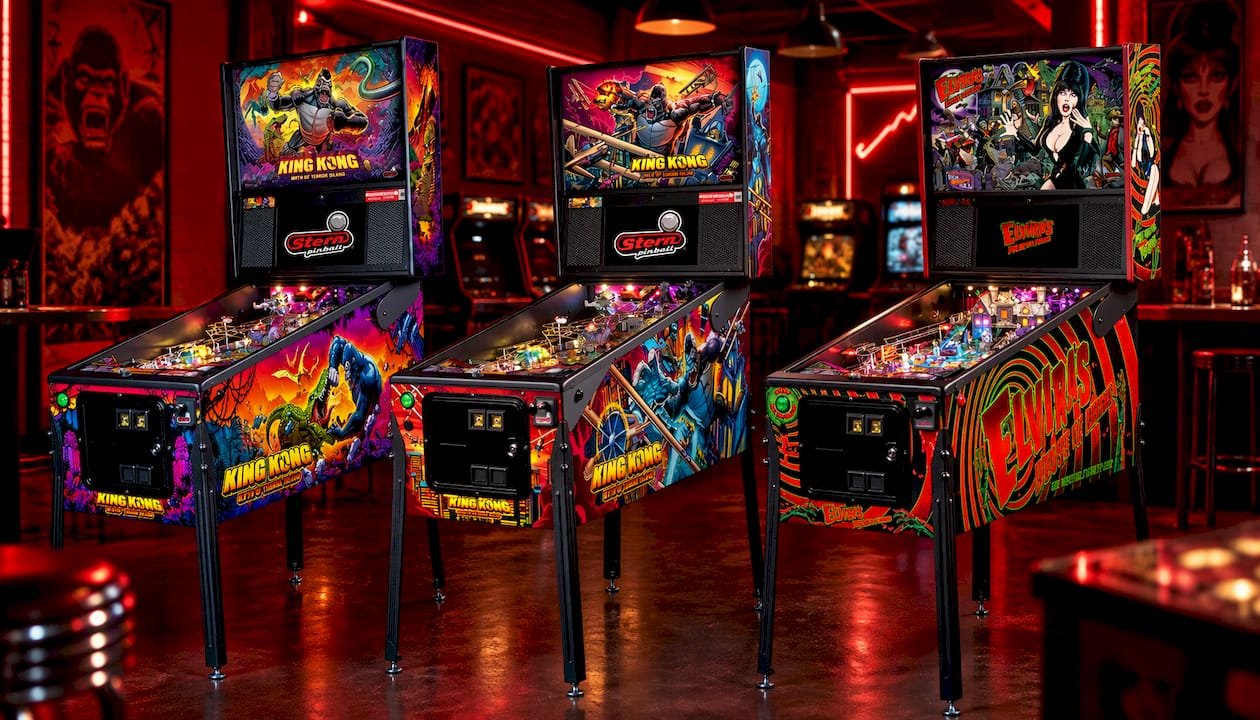
Start with our Stern Pinball machines, look at the full range of pinball machines, or add finishing touches from Stern accessories. If you have a machine to sell or trade, start at the Old Town Pinball home page.
If you want help choosing between makers first, our guide to the best pinball brands in the USA covers the main manufacturers.
FAQ
When was the first pinball game?
The roots go back to 18th-century French bagatelle, and a spring plunger was added in 1870. The coin-operated pinball machine appeared in 1931 with Whiffle and Baffle Ball. Some sources give 1930 for early games, but 1931 is the year museum sources use.
When did pinball get flippers?
Flippers arrived in 1947 with D. Gottlieb & Co.’s Humpty Dumpty. Before that, players could launch the ball but could not steer it. Flippers added timing and aim, and nearly every machine since has used them.
Was pinball ever banned?
Yes. New York City had a pinball ban for more than four decades, and it ended in 1976. A lobby led by Roger Sharpe helped show that the game was one of skill.
What was the first pinball machine with a microprocessor?
Mirco Games’ The Spirit of ’76, released in 1975, was the first machine powered by microprocessors. It helped push the industry toward electronic games.
Sources
- Pinball | National Toy Hall of Fame | The Strong
- Pinball in America, Google Arts & Culture
- Play Meter, October 15, 1986 issue, eLibrary
- GW Magazine, Spring 2011
- Interview: Roger Sharpe, Pinball Magazine
- About Stern Pinball
- How Stern Pinball has survived for 4 decades, GamesBeat
- Smithsonian Magazine on pinball and pop culture
- Spooky Pinball, Wikipedia