
To replace a pinball backglass, first identify the exact glass for your machine from its parts list. Then choose between a reproduction glass, a restoration of your original, or a translite where one fits. Finally, remove the old glass slowly through the backbox and install the new one with the same care. A restored or reproduced glass typically runs a few hundred dollars. The part most owners get wrong is fit: size, thickness, lit areas and chrome all have to match.
This guide walks through each step, from finding the right part number to protecting the artwork once it is back in the machine.
TL;DR
- Look up your machine’s parts list first. It gives the glass part number and size, which saves you from ordering the wrong piece.
- Your options are an original glass, a reproduction, a restoration of your own artwork, or a translite. Each suits a different machine and budget.
- One restoration service reports $225 to $300 for a restored glass, plus roughly $50 to $100 for shipping in the continental US, with turnaround of 4 to 24 weeks.
- Remove the glass by unlocking the backbox, lifting it with the channel and sliding it out carefully. Wrap anything you take out.
- Rare titles can still be reproduced from a good scan of an original.
Table of Contents
- What a backglass is and why replacement is not a simple swap
- Step 1: Identify the glass your machine needs
- Step 2: Choose your replacement route
- What replacement costs in the US
- Rare and discontinued machines
- Step 3: Check that the replacement fits and works
- Step 4: Remove and install the glass safely
- Protect the artwork you keep
- Our perspective
- Find the right machine, glass included
- FAQ
- Sources
What a backglass is and why replacement is not a simple swap
The backglass is the decorated panel at the top of the cabinet, in the backbox, behind the score displays. It carries the game’s artwork, and it is the first thing a player sees across a room.
It is also a working part of the lighting. On a traditional glass, the artwork is screen-printed ink on the rear surface. Lit areas are backed with a thin layer of opaque white to spread the bulb light, while unlit areas use dense silver or black to block it. That is why a replacement has to do more than look right. It has to let light through in the right places and stop it in the others.
That is also why a cheap print from a photo rarely satisfies. A glass that looks great switched off can look blotchy or washed out once the bulbs come on.
Step 1: Identify the glass your machine needs
Start with the manufacturer’s parts list for your exact title and production run. Parts lists give a part number for the whole assembly, and often for the glass and the artwork separately.
Here is a real example. The 1992 Williams Fish Tales parts list shows the back glass assembly as A-8552-50005. It lists a clear glass, 08-7456, measuring 27 x 18-7/8 inches, and a screen-printed translite, 31-1357-50005. One title can therefore involve more than one component, and you need to know which one you are replacing.
Then confirm the visual side:
- Find your machine’s entry in a pinball database and compare the backglass image with yours. Some databases, such as the Internet Pinball Machine Database entry for Bally Fore, include backglass images with dimensions.
- Measure the opening and the glass you have, if it is intact. Measure the glass itself, not the backbox.
- Note the era. Electromechanical (EM) glasses and solid-state glasses are made differently, and that matters for the replacement route.
- Check whether your machine uses a true glass, a translite, or a glass with a translite behind it.
If you bought your machine recently, the seller should be able to tell you which version of the artwork it carries. When you buy from us, you can ask which glass a machine has before it ships.
Step 2: Choose your replacement route
There is no single best option. The right one depends on the era of the machine, how much of the original remains and how original you want the result to be.
| Route | Best for | What to know |
|---|---|---|
| Original glass (used or new old stock) | Machines where originality matters | Condition varies. Check for flaking ink and scratches, and confirm the title and size. |
| Reissue or reproduction glass | Popular titles with a current run | Usually the simplest route when a title is in production. |
| Restoration of your own artwork | A glass with missing ink that you want to keep original | The artwork is scanned, corrected and reprinted onto the original glass. |
| Custom one-off reproduction | Rare or discontinued titles | Takes longer and relies on a clean scan of the artwork. |
| Translite replacement | Machines that used or can take a translite | Often a sound alternative. See below. |
Restoration of the original glass
One restoration service describes the process like this: the original artwork is scanned, flaws and missing artwork are corrected digitally, and the art is reprinted either in full or in sections onto the original glass. For a full restoration, it can use new tempered glass of the right thickness. The same page says the art is bonded directly to the glass in a digital process, rather than silk-screened.
The benefit is that you keep the character and proportions of your own glass. The trade-off is time, which we cover in the cost section.
Translites
A translite is a printed film or sheet that sits behind clear glass and takes the place of ink printed on the glass itself. A reproduction guide notes that translites are still often available but can be expensive. The same guide notes that a backglass can be recreated as a translite. The result is usually less faithful than the original, but it is a reasonable choice for many owners.
If your machine shipped with a translite from the factory, replacing it with a clean reproduction translite is the natural route. If it shipped with a printed glass, a translite is a different look, so decide whether that matters to you.
What replacement costs in the US
Prices vary by title, size, finish and who does the work, so treat any figure as a starting point. Here is what one restoration service publishes: restoration generally costs $225 to $300, depending on the size of the glass, with shipping usually about $50 to $100 in the continental US. That page describes turnaround as typically 4 to 24 weeks. The range depends on whether the title’s artwork has been restored before, and on whether an odd-size sheet of tempered glass has to be ordered, cut and tempered.
That last point is worth planning around. If your machine is out of commission while you wait, shipping your original glass out and waiting weeks is a real cost. Some owners keep the machine playable with the old glass until the new one arrives. Others swap in a spare.
Budget for these items too:
- Shipping both ways. Glass is fragile. Pay for proper packing and insurance.
- New hardware. Lock parts, lift-channel pieces and bulbs are cheap, and replacing them while the glass is out saves a second teardown.
- Backbox cleaning. With the glass out, you have clear access to the lamps and the inside of the backbox.
If you are replacing a glass as part of buying a machine, the shipping cost of the whole machine also matters. Our guide to pinball machine shipping cost covers what to expect, and our financing guide covers spreading a larger purchase.
Rare and discontinued machines
When no reissue exists, you are in custom territory. The same restoration service says that if a reissue glass is not available or sells out, it can provide custom one-off restorations for rare games. The route always starts with the artwork.
A collector forum thread on reproduction advises starting with a good baseline image: use an existing backglass scan if one exists, or ask a fellow collector who owns the glass for a full scan. A sharp scan of an undamaged glass makes every later step easier.
Two more points from the reproduction guides:
- EM glasses are generally easier. The reproduction guide says EM backglasses have no chrome, while many solid-state glasses do, which adds complexity.
- Shortcuts have limits. Film-based replacements may not suit glasses with mirrored areas, cutouts or effects that came from the original silk-screen process. A cheap film copy can work for a plain EM design and fail on a complex one.
Step 3: Check that the replacement fits and works
Before you pay, run this checklist.
- Part number and title. Match the glass to the parts list entry for your machine.
- Dimensions and thickness. Compare the listed size with your measurements. Odd sizes are why some jobs take months.
- Lit and unlit areas. Ask how the lit areas are diffused and how the unlit areas block light. The layers behind the color matter. One guide describes three layers for an accurate recreation: a color layer, a white translucent layer to smooth light, and a chrome layer that blocks light and imitates chrome on solid-state games.
- Chrome or mirrored areas. If your original has them, make sure the replacement handles them.
- Lock and channel. Confirm that your lock, lift channel and trim still match the new glass.
- Glass type. Confirm whether you need tempered glass.
An accurate scan is necessary but not enough on its own. The layers have to do their job once the lights are on.
Step 4: Remove and install the glass safely
Glass breaks, and a backglass is often the most valuable single piece of art on the machine. Take your time and work with a helper if the glass is large.
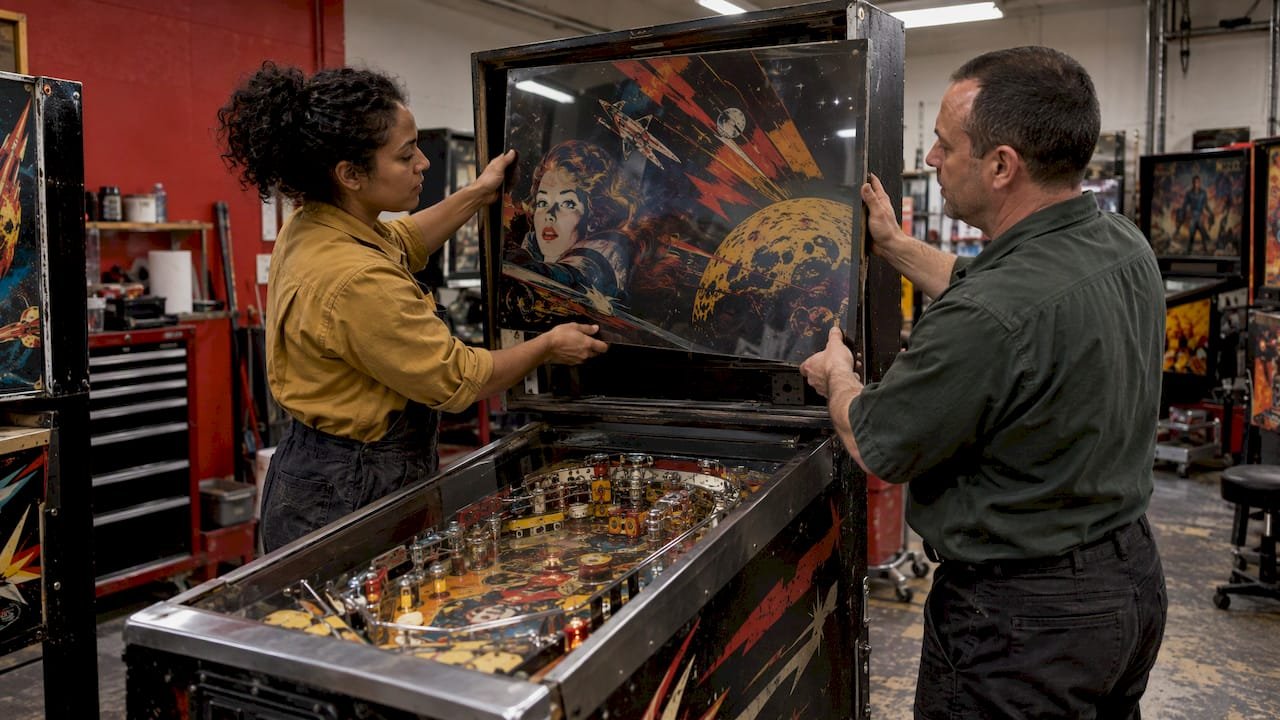
The steps vary by manufacturer and era, so check your machine’s manual first. The general approach for earlier machines, as advised by a pinball moving company, is to unlock the headbox, lift the glass carefully with the lifting channel, pull it out through the bottom, and wrap it in suitable packing material.
A practical sequence:
- Unplug the machine and let the bulbs cool.
- Open the backbox with its key and lay out a clean, soft surface.
- Lift the glass slightly with the channel to clear the lower lip, then tilt the top toward you.
- Slide it out and set it on its long edge on padding, painted side protected.
- Photograph the lock, channel and trim positions before you remove anything else.
- Install in reverse. Engage the lock afterward, since the lock is part of reassembly. Spooky Pinball’s Evil Dead maintenance manual describes reinstalling the back glass and engaging the lock, and advises care when handling glass.
Wear gloves if you are handling a printed glass, and never lean the glass against anything with a rough surface. Do not clean the printed side with spray cleaners. If you are unsure, ask the restorer how to clean that glass.
Protect the artwork you keep
If your original glass is mostly intact, the best replacement may be to keep it, and protect it.
- Do not touch up valuable artwork on a whim. A restoration specialist advises that a valuable game’s backglass should only be retouched after lots of practice on plain glass and junkers, because a poor touch-up can be worse than none.
- Handle by the edges and store the glass upright, padded, with a protective layer against the printed side.
- Ship it properly. If it has to travel, pack it as you would a framed painting.
- Keep dust and spills away from the backbox. A pinball glass dust cover helps keep the playfield glass clean between sessions.
Our perspective
We sell new and used pinball machines every week, and the backglass is often the first thing a buyer looks at. It is the art, the title and the first impression, all in one panel. A clean glass makes a machine feel complete.
That is why we think about glass condition before a machine ever ships. As an authorized dealer for brands such as Stern Pinball and Spooky Pinball, we offer new machines that come with their artwork in factory condition. For collectors who want a used title, our buy, sell and trade service is a way to find a machine whose glass already looks right, instead of starting a restoration from scratch.
If you do need a replacement, our advice is simple. Identify the part, match it to the machine’s era, and do not rush the removal. A careful hour is cheaper than a broken glass.
the author
Find the right machine, glass included
A replacement glass is a good fix. A machine that arrives with great artwork is an easier start. We carry new and used machines from major brands, along with official accessories such as toppers and art blades, and we deliver to the Lower 48 states.
Browse our current pinball machines, look through Stern accessories, or see the full range on the Old Town Pinballs home page. We also accept Bitcoin and other cryptocurrency at checkout.
If you want to see what our machines look like before you buy, our photo gallery shows machines up close, and our guide to pinball cabinet decals covers the other big visual upgrade.
FAQ
How much does a pinball backglass replacement cost?
One restoration service publishes a range of $225 to $300 depending on glass size, plus about $50 to $100 for shipping in the continental US. Your cost depends on the title, size and route. A reissue, a translite and a custom one-off all price differently.
How long does a replacement or restoration take?
The same service reports a typical turnaround of 4 to 24 weeks. Longer waits come from artwork that needs heavy correction or from odd-size tempered glass that must be ordered and cut. Ask for a current estimate when you place an order.
Can I replace a backglass with a translite?
Often yes. A backglass can be recreated as a translite, and the result is usually less faithful to the original but reasonable. It works best on machines that suit it. Complex glasses with mirrored areas or special effects may not translate well.
Can a rare or discontinued machine get a new backglass?
Yes, usually through a custom one-off reproduction. The key is a clear, complete scan of an original glass. If you do not own a good one, a collector with the same title may be able to supply a scan.
How do I take a backglass out without breaking it?
Unplug the machine, unlock the backbox, lift the glass with the lift channel and slide it out through the bottom with a helper if it is large. Wrap it in padding and store it upright. Check your machine’s manual first, since the details vary by manufacturer.
Sources
- Williams Fish Tales parts list (1992)
- Internet Pinball Machine Database: Bally Fore
- Backglass restoration service page
- Pinball backglass and translite reproduction guide
- Forum thread on reproducing a backglass
- Playfield and backglass restoration page
- Tips on moving a pinball machine
- The Evil Dead maintenance manual
One Response