
A pinball machine does not lose value the way a car does, but it does not stand still either. The biggest drop usually lands on the first owner of a new machine. After that, prices depend mostly on the title, the condition and the timing of the sale. If you buy the right title in good shape and keep it clean and working, the cost of owning it can come down to a small monthly figure.
This guide covers how much machines typically lose, what the U.S. used market has done in recent years, what condition and restoration do to resale, and how to buy so your numbers stay on your side. It is written for collectors, new enthusiasts, families and business owners who want a machine in the room and want to know what it will be worth later.
TL;DR
- Depreciation is steepest for the first owner of a new machine. A second-hand buyer often lands closer to the stable part of the price curve.
- Title demand and condition move price more than age or rarity. A machine’s value can also shift from one year to the next with no change to the machine itself.
- Restoration can protect value when it is done well and documented, but labor rarely comes back dollar for dollar.
- Think in cost per month of ownership. A $12,000 machine sold for $9,000 after two years costs $125 a month in depreciation.
- Buying from an authorized dealer, with clear condition and delivery, makes the later sale easier.
Table of Contents
- What depreciation means for a pinball machine
- How much do pinball machines lose in the first years?
- What the U.S. used market has actually done
- The factors that decide resale value
- Does restoration add value?
- A condition ladder for older machines
- How to buy so depreciation works for you
- Our view: value is made at the purchase
- Find a machine that fits your numbers
- FAQ
- Sources
What depreciation means for a pinball machine
Depreciation is the gap between what you pay for a machine and what you can sell it for later. For pinball, that gap is the real cost of owning the game, apart from repairs, parts and electricity.
A simple way to think about it comes from a worked example on used pinball prices: buy a machine for $12,000, sell it two years later for $9,000, and you have lost $3,000. Spread over 24 months, that is $125 a month before any other expense. For comparison, that is a reasonable price for a piece of entertainment that fills a room, draws every guest to it and can be played every day.
That monthly framing is useful for every kind of buyer:
- Families can weigh it against other entertainment spending.
- Business owners can treat it as the equipment cost per month of a game that earns attention and play.
- Collectors can compare it with the appreciation or stability of specific titles.
How much do pinball machines lose in the first years?
There is no single percentage that fits every machine. Some titles drop quickly and then level out, some hold, and a few climb. What the research shows is a pattern, not a rule.
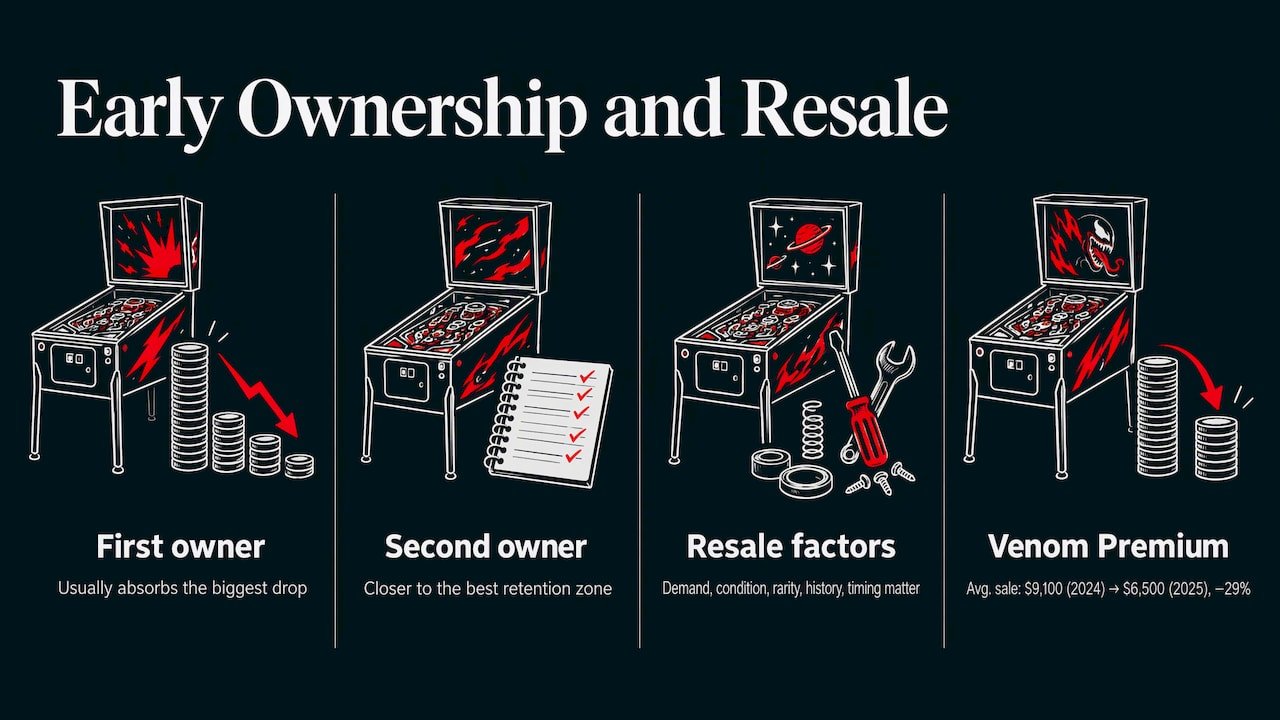
Community discussions summarized in a guide on pinball as an investment describe the same shape: the first owner of a new machine usually absorbs the biggest drop, and the second owner sits closer to the best value-retention zone. Resale then depends on title demand, condition, rarity, maintenance history and market timing.
The same title can also move sharply with no change to the machine. Pinball Xperience reports that the Venom Premium’s average selling price in the U.S. fell from about $9,100 in 2024 to $6,500 in 2025, a 29% decline in a single year. It is a reminder that a hot title can cool as new releases arrive and buyers shift attention.
What the U.S. used market has actually done
The used market has gone through a boom and a cooling. Looking at a few independent trackers shows both.
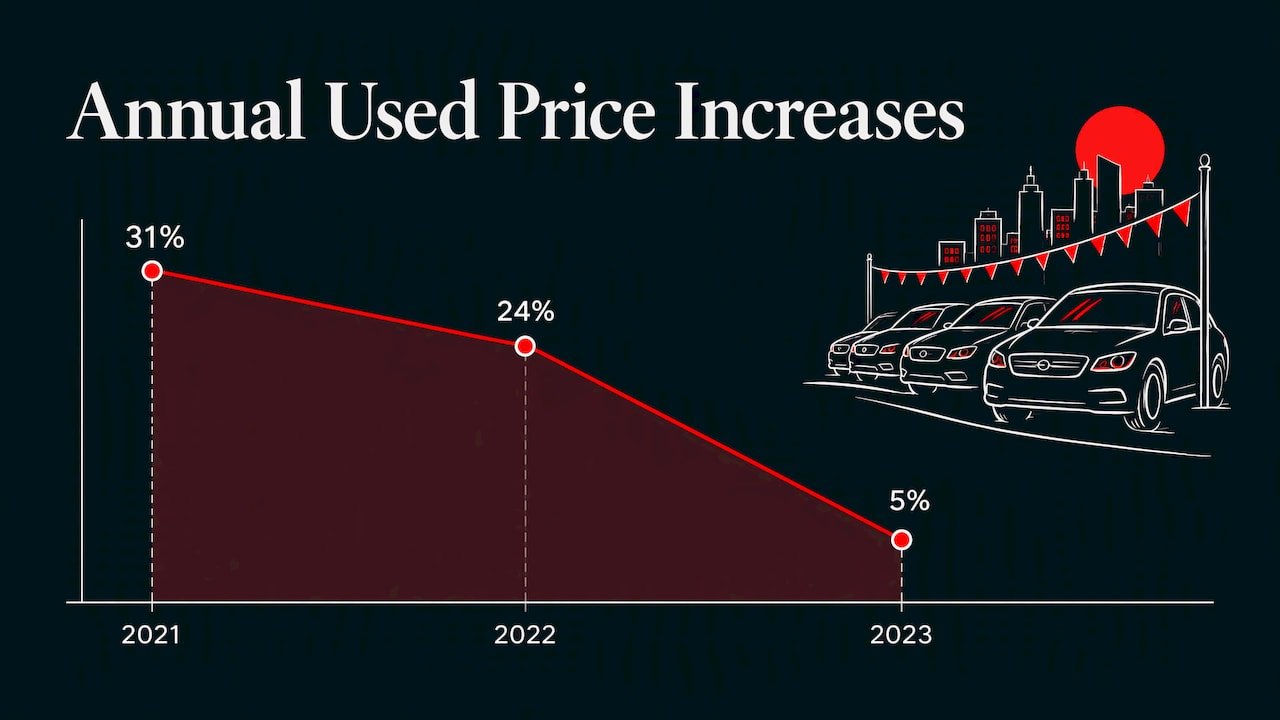
The boom. Kineticist’s analysis of final sale prices found that the average used machine price rose 31% in 2021 and 24% in 2022, then only 5% in 2023. The 2023 average across all machines was $5,684. Golden Age DMD games from 1992 to 1998 averaged $5,602, still 45% above 2018 levels.
The cooling. The PinballPrices.com trends page shows used machines overall sold for about 1.1% less in 2025 than in 2024. LCD machines made since 2016 did not rise in median price after two years of decline. That site’s price guide draws on more than 13,550 recorded sales across 1,510 titles, which makes it a useful reference for any specific title.
Different indexes, different readings. Another tracker, the Silverball Labs market index, has reported a strong year-over-year reading for the overall market, with early solid-state and electromechanical games doing especially well. It notes that recent sales coverage is limited while it rebuilds its sources. Methods differ, so use these figures as direction, and always check the exact title you care about.
The lesson is that “the pinball market” is really many small markets. A quick look at one early-November 2026 analysis cited by Pinball Xperience shows how mixed it is: Evil Dead was up 15% on its annual average, The Addams Family up 6%, Winchester up 4% and TMNT Limited Edition 13% above its original U.S. list price, while Harry Potter, Medieval Madness and Attack from Mars faced downward pressure.
These are published figures for their period, and they move as new sales are recorded. Before you buy or sell, check the live price guide for your title rather than relying on any article’s snapshot, including this one.
The factors that decide resale value
Five things do most of the work.
1. Title demand
A fun, well-known game with strong rules sells. Rarity alone does not. PinWiki points out that The Addams Family, with 21,000 units built, the highest production run of the modern era, still commands a high price, while another game from the same period can be found for a fraction of it. Scarcity matters only when demand exceeds supply.
2. Condition
Working order, cabinet and playfield wear, displays, flippers and bumpers all feed the price. The problems that hurt most are battery corrosion on older boards, water damage, worn inserts and scoops, hacked wiring, poor repaints and missing original parts such as plastics, boards and translites, as listed in a guide on holding value.
3. Originality
Originality is not an automatic premium. PinballZen’s appraisal guide notes that an untouched machine with faded art, dirty boards and weak flippers is not necessarily worth more than a professional restoration. Aftermarket parts, wrong decals or mismatched hardware narrow the audience of serious buyers.
4. Age
Age matters less than most people expect. A fifty-year-old machine can be valuable, but if the title is not in demand it can be expensive to restore and slow to sell.
5. Timing and place
Prices shift with the market cycle and with logistics. A machine that is easy to deliver and inspect reaches more buyers than one that has to be collected from a distant basement.
Does restoration add value?
Well-done restoration can protect value, but it rarely pays back dollar for dollar. The investment guide cited earlier rates restored machines as able to hold value when the work is good, and finds lightly used machines to be the best balance of price and resale retention. Project machines are the weakest choice unless you can repair them yourself.
Three things separate a restoration that supports the price from one that does not.
Respect the title. PinballZen argues the best restorations preserve or correctly recreate factory character while making the machine reliable.
Document the work. Invoices, before-and-after photos, parts lists and technician notes turn a restoration claim into evidence a buyer will pay for.
Know what the glass and art are worth. If a backglass is faded or damaged, see our guide on pinball backglass replacement for options, costs and fit before you decide what to spend.
What restoration costs
Published figures help you set a ceiling before you start. PinWiki’s breakdown puts a cleanup of a dirty but undamaged machine at about 40 hours plus $400 in plastics, rubbers, lamps and materials, and another $200 for legs, door and trim. A playfield swap adds about 40 hours and $600 to $900, and cabinet decals add about 20 hours and $300.
One documented electromechanical rebuild on Pinside totals about $2,400, which means the owner would need to sell near $3,000 to break even on a game with a $300 base value. At the other end, a documented Addams Family restoration came to $13,198.35 after selling old parts, with more than 500 hours of labor.
The takeaway for buyers: pay for condition that is already there, and restore for the love of the game rather than expecting the sale price to cover every hour.
A condition ladder for older machines
An older price ladder from the Museum of the Game shows how steeply condition moves price on a typical vintage machine. Its figures date from the 2000s, so use them for the shape, not for today’s dollars.
| Condition | Typical range in that guide |
|---|---|
| Non-working or gutted | $0 to $50 |
| Complete, not working | $25 to $100 |
| Working but unattractive | $100 to $200 |
| Working and good-looking, untouched for 10+ years | $200 to $400 |
| Rebuilt internals, worn cabinet | $300 to $600 |
| Fully restored inside and out | $500 to $3,000 |
| Never-played, factory-fresh | $750 to $3,000+ |
The step from “works” to “works and looks right” is where most of the value is created.
How to buy so depreciation works for you
You cannot control the market, but you can control what you pay and what you buy.
- Choose a title you will play for years. Strong demand and a game you love are both protection. If you want something with built-in scarcity, our guide to limited edition pinball machines explains what you get and how to buy.
- Look at the real sale history. Compare final sale prices for your title, not asking prices. Kineticist’s method records final prices, including buyer’s premiums of 10% to 28%, from online auction sites, which is why it is a better guide than listings.
- Prefer clean and complete. Lightly used machines in good shape keep their appeal. Missing parts and hacked wiring are what cost money later.
- Decide new or used by how you plan to hold it. A new machine gives you the full warranty period and the latest features. A used one lets someone else absorb the first drop. Both are reasonable; the right one depends on your budget and how long you will keep it.
- Plan the exit. Know whether you will sell, trade or keep. A trade-in path makes the next machine easier to afford.
- Budget the monthly cost. Divide the expected loss by months owned, as in the $125 example above, and add maintenance.
For buyers spreading the cost, our overview of pinball machine financing covers the options and costs. Business owners comparing equipment budgets can also look at arcade machine costs.
Our view: value is made at the purchase
We talk to buyers every day who ask the same thing: what will this be worth later? Our answer is that the price you pay and the machine you pick matter more than any forecast.
A machine from a major brand, bought from an authorized dealer, in a condition you can see described clearly, gives you the best footing. We are an authorized dealer for Stern Pinball and Spooky Pinball, and we carry new and used machines, so you can choose the stage of the price curve that suits you.
The buy, sell and trade service exists for the same reason. When your tastes change, or you want the next release, you have a way to move one machine on and bring the next one in. Nationwide delivery to the Lower 48 means location does not limit the machine you can choose, and we accept Bitcoin and other cryptocurrency for buyers who prefer it.
Treat a pinball machine as something you play first. Pick a title you love and keep it in good order. Resale then takes care of itself far better than it does for a machine bought only as a bet.
the author
Find a machine that fits your numbers
If you are ready to compare, start with our full range of new and used pinball machines, or go straight to the Stern Pinball machines we sell as an authorized dealer. Accessories such as toppers, art blades and parts are in the Stern accessories category.
If you already own a machine and want to move it on or trade up, our buy, sell and trade service is the place to start, with nationwide delivery across the Lower 48.
FAQ
Do pinball machines hold their value?
Many do, within limits. A well-bought used machine that is kept in good working order can stay close to its purchase price, and collector-grade titles can hold or rise, as summarized in this guide. Overall, used prices were about 1.1% lower in 2025 than in 2024, so the market has been stable rather than surging.
Who takes the biggest loss, the first owner or the second?
The first owner of a new machine usually absorbs the largest drop. The second owner tends to buy closer to the stable zone, according to community reports summarized in the investment guide. A new machine still brings the latest features and a fresh start.
Does restoring a machine raise its price?
It can, if the work is correct for the title and well documented. Labor rarely comes back in full, so set a budget against what comparable machines sell for. Our guide to backglass replacement is a useful starting point for one of the most visible parts.
Which things hurt resale the most?
Battery corrosion, water damage, worn playfield inserts, hacked wiring, poor repaints and missing original parts are the most common problems. A machine that is complete, clean and working sells faster and for more than a similar one with these issues.
How do I check what a specific machine is worth?
Look at final sale prices for the same title and condition, not asking prices. A price guide built on recorded sales is a good place to start, and the figures change as new sales are added, so check the live data on the day you decide.
Sources
- Used Pinball Prices 2026: Values, Trends & Depreciation
- Are Pinball Machines a Good Investment? Value, Risks, and More
- Do Pinball Machines Hold Their Value? The Real Answer
- Pinflation on Ice: Used Pinball Prices Up Only 5% in 2023
- Pinball Price Trends, PinballPrices.com
- Pinball Prices, price guide
- Pinball Price Trends: Market Index and Era Performance
- What is a Pinball Machine Worth? PinWiki
- Pinball Collection Appraisal: Know What You Own
- Videogame and Pinball Buying and Selling Tips, Museum of the Game
- EM price check for better-than-new restos, Pinside
- My roughly $11k TAF restoration, Pinside