
A pinball machine does not ship like a package. It travels as freight, usually strapped to a pallet or crated, and typically reaches a U.S. address in about 3 to 10 business days. At Old Town Pinballs we offer nationwide delivery to the lower 48, so a machine from our shop can land in your home, game room or business. This guide explains how delivery works, what moves the price, how long it takes, and what to do on the day the truck shows up.
TL;DR
- Pinball machines weigh 250 to 300 pounds or more, so they ship by freight carrier, not parcel service.
- Wrapped freight is the standard method; white-glove service suits high-value or collector machines.
- Door-to-door shipping within the continental U.S. is commonly quoted at roughly $800 to $1,300, with transit of about 3 to 10 business days. Quotes vary by route and service.
- Plan for the delivery end: a liftgate, a clear path, and a second person to help.
- Note any damage on the delivery paperwork before you sign, then take photos.
Table of Contents
- Why a pinball machine ships as freight
- Three ways a pinball machine can travel
- What nationwide delivery costs
- How long delivery takes
- Prepare your space before the truck arrives
- How a machine is prepared for the road
- Insurance: what the carrier covers and what it does not
- Delivery day: what to check
- Perspective: why delivery is part of the machine
- Choosing the right level of delivery for your machine
- Shop with delivery in mind
- FAQ
- Sources
Why a pinball machine ships as freight
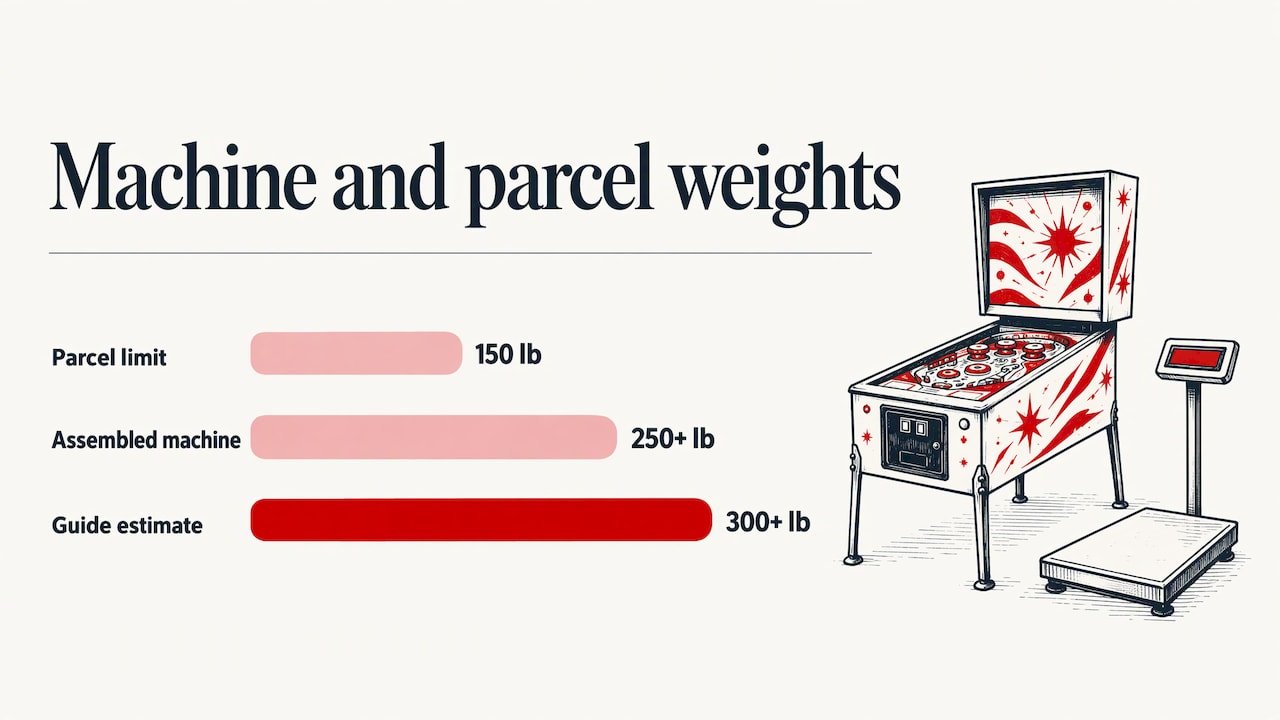
A fully assembled machine often weighs 250 pounds or more, well past the 150-pound package limit of the big parcel carriers. Another guide puts a finished machine at 300 pounds or more and says most should go by freight carrier.
That changes how you plan. Freight means a truck, a delivery window, a driver with a pallet jack and a decision about how far into your home the machine goes. None of it is difficult, but it is worth understanding before the delivery day, not during it.
Three ways a pinball machine can travel
Shipping specialists generally describe three tiers, and the Coin Machine Shippers guide lays them out like this.
| Method | How it works | Best for |
|---|---|---|
| Open LTL freight | The machine rides on a shared truck with minimal protection | Low-value machines, tight budgets |
| Wrapped freight | Legs off, backbox secured, cabinet strapped flat on a pallet and wrapped in blankets and stretch film | Most nationwide pinball shipments |
| White-glove specialty | Padded, often air-ride transport with appointment delivery | High-value machines, restored vintage games, collector pieces above about $5,000 declared value |
One more option sits inside freight: crating. For LTL shipments, crating is strongly recommended, and many carriers require it for items over 150 pounds or valued over $1,000. A proper crate uses a lumber frame, sheathing, foam padding on all sides, and the machine bolted to the base.
A brand-new machine in its factory carton is already built for this journey. A restored or rare game is a different story, because it is irreplaceable, and extra protection is cheap compared with the machine.
What nationwide delivery costs
Shipping rates move with distance, weight, the service level and how fuel and freight demand look that month, so treat every number here as a range and ask for a current quote.
Published estimates from shipping specialists:
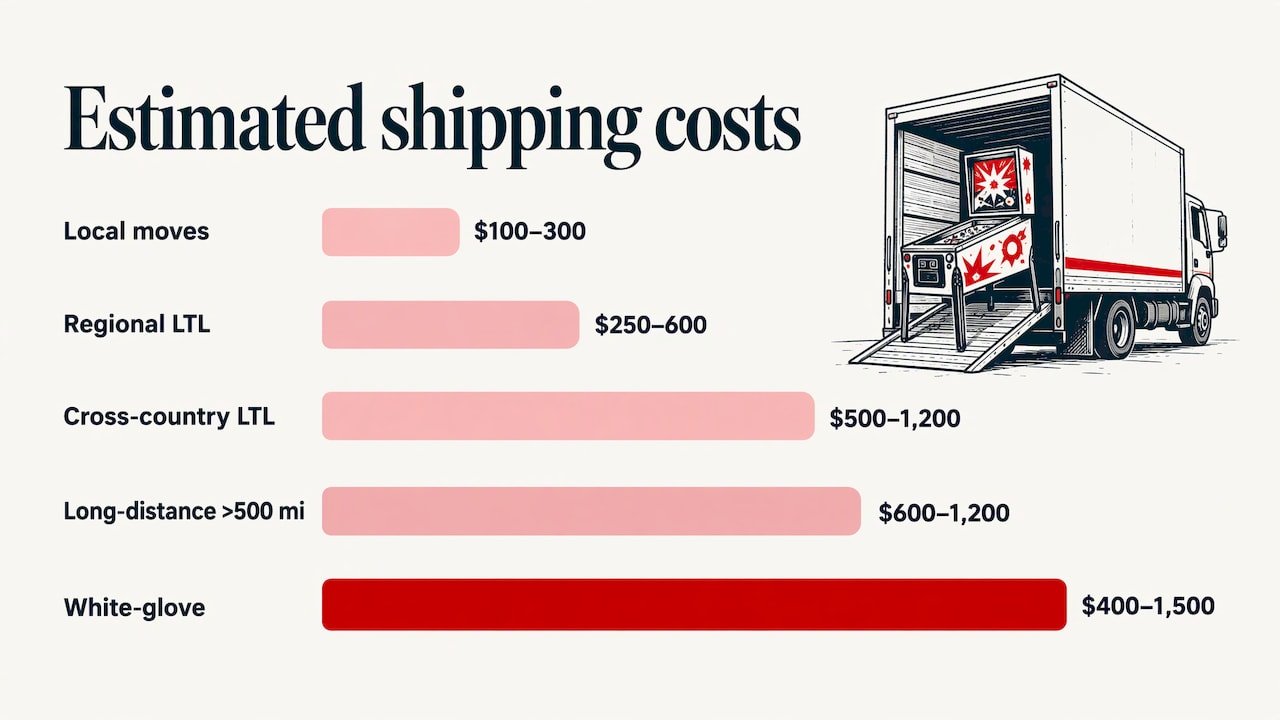
- Most machines ship door to door within the continental U.S. for $800 to $1,300, with regional moves at the low end and coast-to-coast near the top.
- A marketplace estimate puts long-distance moves over 500 miles at $600 to $1,200 depending on distance and service level, and local moves at about $100 to $300.
- Average LTL freight is listed at $250 to $600 regionally and $500 to $1,200 cross-country, with white-glove at $400 to $1,500.
The spread is wide because the inputs differ. For a deeper breakdown, see our guide to what it costs to ship a pinball machine.
What pushes the price up or down
- Distance. A neighboring state costs far less than a coast-to-coast run.
- Service level. Wrapped freight is the baseline. Crating, white-glove handling and appointment windows add cost.
- Residential delivery. A liftgate lowers the machine from the truck to the ground. Residential liftgate service can add $75 to $125 per end.
- Inside delivery. Placing the machine in your room costs more than curbside and may not be available in every area.
- Insurance. Covered below.
How long delivery takes
Transit time depends on the route and the service. Typical ranges:
- Wrapped LTL freight takes 3 to 7 business days on most U.S. routes, and cross-country white-glove shipping takes 5 to 14 days with appointment delivery.
- Most cross-country shipments run 5 to 10 business days, with East to West Coast routes at the upper end, 7 to 10 days.
That is transit, not the whole timeline. Allow time before pickup for the machine to be prepared and for the carrier to schedule it. When you buy a machine, ask for the pickup and delivery estimate for your zip code before you commit to a party date or a business opening.
Prepare your space before the truck arrives
Most delivery headaches come from the receiving end. A day before delivery, walk the route from the driveway to the final spot.
- Measure the path. Doorways, hallways, turns and stairs. A standard cabinet is not narrow, and a crated machine is wider than a bare one.
- Think about the truck. Freight trucks are big. If your street is narrow or has a steep grade, tell the carrier when scheduling.
- Ask about a liftgate. Unless you have a loading dock, you will want one. A driver with a pallet jack can move the pallet to the curb or garage, but not much further.
- Line up help. If the machine arrives curbside, you will need at least two capable adults and ideally a dolly or ramp for the last stretch.
- Choose the spot. Pick a level area away from damp walls and direct sun, and leave room to open the coin door and lift the glass.
- Be reachable. Freight carriers call to set a delivery window. A missed call can mean a rescheduled slot.
How a machine is prepared for the road
Whether the machine comes from a shop or you are sending one out in a trade, preparation protects the playfield and the electronics. The usual steps from shipping guides:
- Remove the balls from the trough and shooter lane, pack the topper and any loose mods, lock the lockdown bar and seat the glass. Dated photos of every side, the playfield and the backglass are a good record.
- Separate the head from the cabinet, secure the playfield with foam wedges or shipping blocks, and wrap the backglass flat in foam between two pieces of cardboard.
- Add corner protectors on cabinet edges, since impacts concentrate there. Palletizing lets a pallet jack or forklift do the lifting instead of people.
- For long trips, packers suggest extra layers of stretch wrap and additional ratchet straps, because the machine spends more days in transit.
- A crate should stop the machine from sliding or tipping in any direction, and the cabinet should rest on its base, not on the backbox or side rails, according to one shipping guide.
If you are trading a machine in, these are the steps worth following before pickup. Ask us about it through our buy, sell, trade service.
Insurance: what the carrier covers and what it does not
Standard carrier liability is low. It is quoted at $0.50 per pound, which is about $140 on a 280-pound machine. The same guide recommends declaring the full value and buying cargo insurance, with premiums typically 1 to 3 percent of declared value.
Some shippers offer simple add-ons, for example $10,000 of coverage for $25 on quotes. Whatever route you take, make sure the declared value matches what you actually paid, and keep your invoice.
Delivery day: what to check
This is where a few minutes protect you. The steps below are standard freight practice. Check the carrier’s paperwork and your insurance policy for the specifics of your shipment.
- Look at the packaging before you sign. Check the pallet, straps, wrap and box for crushed corners, punctures, tears or signs the machine was tipped.
- Note any damage on the delivery receipt. If you see anything, write it on the paperwork before you sign, with the driver present, and keep a copy. Signing a clean receipt can make a later claim harder.
- Take photos. Capture all sides, the damage, the labels and the pallet, before anything is opened.
- Unpack carefully, keep the packing. Keep the boxes and foam until you know the machine works. They matter if you need to file a claim.
- Inspect the machine. Check the cabinet, legs, backglass, playfield glass, the playfield itself and the coin door. Look for loose parts, bent ball guides and cracked plastics.
- Power up and test. Level the machine, plug it in and run a few games. Check the flippers, the display and the switches.
- Report quickly. If you find hidden damage after unpacking, contact the seller and the carrier promptly and send your photos. Do not wait.
When the machine comes from us, contact us right away if anything looks wrong so we can help you work through it.
Perspective: why delivery is part of the machine
We think of delivery as the last step of building the machine, not an afterthought. A pinball machine can be perfect on our floor and still disappoint if it is poorly strapped, left on a curb, or set up without a plan.
That is why we are an authorized dealer for brands like Stern Pinball and Spooky Pinball, and why we ship to the lower 48. We want a new release or a collectible to reach you as it left us, wherever you live, whether you are a first-time buyer, a family adding a game room or a business owner adding an arcade attraction.
Our advice is simple: tell us about your space, ask about delivery for your zip code, and plan the receiving end before the truck is booked. We would rather answer ten questions up front than rush a fix after the fact.
the author
Choosing the right level of delivery for your machine
A simple way to decide:
- A modern machine in the factory box, going to a home with a driveway and two helpers: wrapped freight with a liftgate is normally the sensible choice.
- A machine going upstairs, into a basement, or to a tight room: ask about inside delivery, or line up extra hands. Inside delivery costs more and isn’t offered everywhere.
- A rare, restored or high-value game: it is common for collectors to pay for a specialty mover with custom crating, padded transport and appointment delivery. The cost is small against the value of the machine.
- A commercial location: a loading dock removes the liftgate fee, but confirm receiving hours and who signs.
One more point for out-of-state buyers: sales tax and registration rules depend on your state and business use. Check with your state’s revenue department or your accountant, particularly for a business purchase.
Shop with delivery in mind
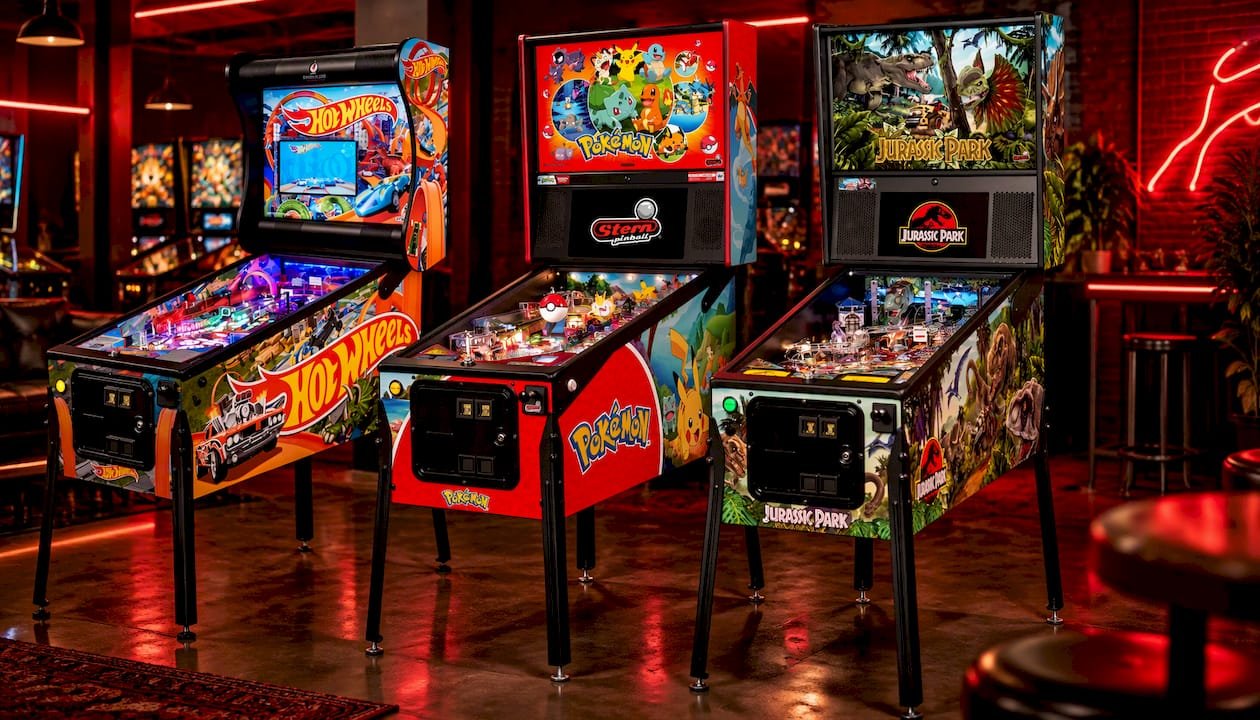
We carry new and used machines from authorized brands, accessories such as toppers and art blades, and a buy, sell, trade service. Browse the full pinball machine collection, the Stern lineup, or American Pinball, or check the current inventory list. Popular picks include the Pokémon Premium by Stern and the Jurassic Park Pro by Stern.
We also accept Bitcoin and other cryptocurrency, and if you want to spread out the cost, our pinball financing guide covers the options. Start at Old Town Pinballs and tell us where the machine is going.
FAQ
Do you deliver pinball machines to every state?
Our nationwide delivery covers the lower 48 states. If you are in Alaska, Hawaii or outside the U.S., contact us before you order so we can talk through your options.
Can a pinball machine be shipped by UPS or FedEx?
Usually not. A full machine commonly weighs 250 pounds or more, above the 150-pound limit that parcel carriers set, so it moves as freight. Small accessories such as toppers or art blades are a different matter and can often travel as packages.
Should I pay for white-glove delivery?
It depends on the machine and the location. A rare or restored game, a long route, or a hard-to-reach room are good reasons. For a modern machine going to a home with easy access, wrapped freight with a liftgate is commonly enough.
What if my machine arrives damaged?
Write the damage on the delivery receipt before signing, photograph everything, keep the packing materials, and contact the seller and the carrier right away. Declared value and insurance affect what a carrier pays, so keep your invoice handy.
Sources
- Pinball Machine Shipping in 2026: Complete Guide
- How to Ship a Pinball Machine: Step-by-Step Guide
- Pinball Machine Shipping, Door to Door Nationwide
- Ship Arcade Machine Across Country
- Shipping Pinball Machines: Crating, Freight & Prep
- How to Ship Pinball Safely Without Damage
- How to Ship a Pinball Machine and What It Costs