
A pinball machine does not arrive the way a package does. It travels as palletized freight, and a home delivery goes smoothly when you know three things in advance: how the machine is shipped, what access your driveway and doorway offer, and what to do at the moment the driver hands it over. Buy from a dealer that ships nationwide and treats delivery as part of the sale, such as Old Town Pinballs, which delivers across the Lower 48, and most of the risk is handled before the truck ever pulls up.
This guide is for people buying a machine for a house, a family game room or a small business space. It covers how the delivery works, what drives the price, how to get your site ready, and how to inspect the machine before you sign.
TL;DR
- A full-size pinball machine is too heavy for standard parcel service, so it ships as palletized LTL freight (less-than-truckload, where your pallet shares a truck with other shipments).
- Residential delivery usually means a liftgate (a hydraulic platform that lowers the pallet to the ground). Stairs, narrow doors and gravel driveways decide whether the machine can go further than the curb.
- Note any visible damage on the delivery receipt before you sign. A clean signature makes a later claim much harder.
- Measure doors, hallways and stairs before you order, and know the machine’s weight. Our pinball machine weight guide covers it.
- We deliver nationwide in the Lower 48, so you can order from home and plan the arrival ahead of time.
Table of Contents
- How residential pinball delivery works
- Why residential delivery costs more than commercial
- Curbside, driveway or inside: what the driver will actually do
- Prepare your home or space before the truck arrives
- How machines are packed for the trip
- The moment of delivery: inspect before you sign
- Delivery questions by buyer type
- Perspective
- Ready to order? Start with the machine
- A delivery-day checklist
- Frequently asked questions
- Sources
How residential pinball delivery works
A modern pinball machine often weighs 250 pounds or more. That is well past the 150-pound package limit that UPS applies, so it moves as a freight shipment instead of a parcel. In practice that means a crate or protective wrap on a pallet, a freight carrier picking it up, a terminal stop or two, and a local truck making the final delivery.
The path from the seller to your door usually goes like this:
- Preparation. The machine is made ready for transport: legs removed, the head folded or detached, glass and balls handled separately, and everything secured to the pallet.
- Pickup. A freight carrier collects the pallet from the seller’s location.
- Line haul. The pallet rides to a regional terminal near you. On a long trip it may pass through more than one.
- Scheduling. The carrier or a delivery partner contacts you to set a window. Answer these calls. A missed call is the most common reason a delivery slips a few days.
- Final delivery. A local truck brings the machine to your address. For a house this normally requires a liftgate.
- Inspection and signature. You check the crate, note any damage, sign, then unpack and inspect the machine.
The seller controls steps 1 and 2, which is why the choice of seller matters. Steps 4 to 6 are where you, the buyer, have the most influence.
Why residential delivery costs more than commercial
Freight quotes depend on the crated weight and dimensions, the freight class, the distance, and extras called accessorials, such as liftgate service and residential delivery. A business with a loading dock does not need a liftgate. A house usually does, and carriers charge for the extra equipment and the slower stop.
That is why two machines of the same weight can be shipped at different prices. The factors that move the number are:
| Factor | What it means for you |
|---|---|
| Distance | Longer routes cost more. A cross-country move costs far more than a regional one. |
| Crated weight and size | The pallet, crate and packing add to the machine’s own weight. |
| Liftgate | Needed when there is no dock. A home delivery almost always includes it. |
| Residential delivery | A surcharge for stops at homes rather than businesses. |
| Inside delivery | Moving the machine past the curb or driveway. It costs more and is not available everywhere. |
| Location | Dense urban areas and some coastal regions can carry higher access fees. |
For the numbers on a particular machine, see our breakdown in the pinball machine shipping cost guide. Rates change with fuel, carrier pricing and season, so treat any figure from a forum thread as a snapshot, not a quote.
Curbside, driveway or inside: what the driver will actually do
The most common surprise in residential pinball delivery is where the driver stops. Freight delivery is normally to the curb or the end of the driveway, with the liftgate lowering the pallet to the ground. Inside delivery is a separate service that costs more and may not be offered everywhere.
Plan on this basis:
- Curbside or driveway: the pallet is lowered from the truck. You or your helpers take it from there.
- Inside delivery: the driver brings it through the door, but only if access allows it.
- Setup: assembling the legs, leveling the machine, installing the balls and checking the switches is usually your job unless the seller says otherwise.
Access issues such as stairs, narrow doors and gravel driveways decide how far the machine can travel. Confirm them before delivery, not on the day.
Prepare your home or space before the truck arrives
A little prep avoids almost every delivery headache. Work through this list a week before the expected date.
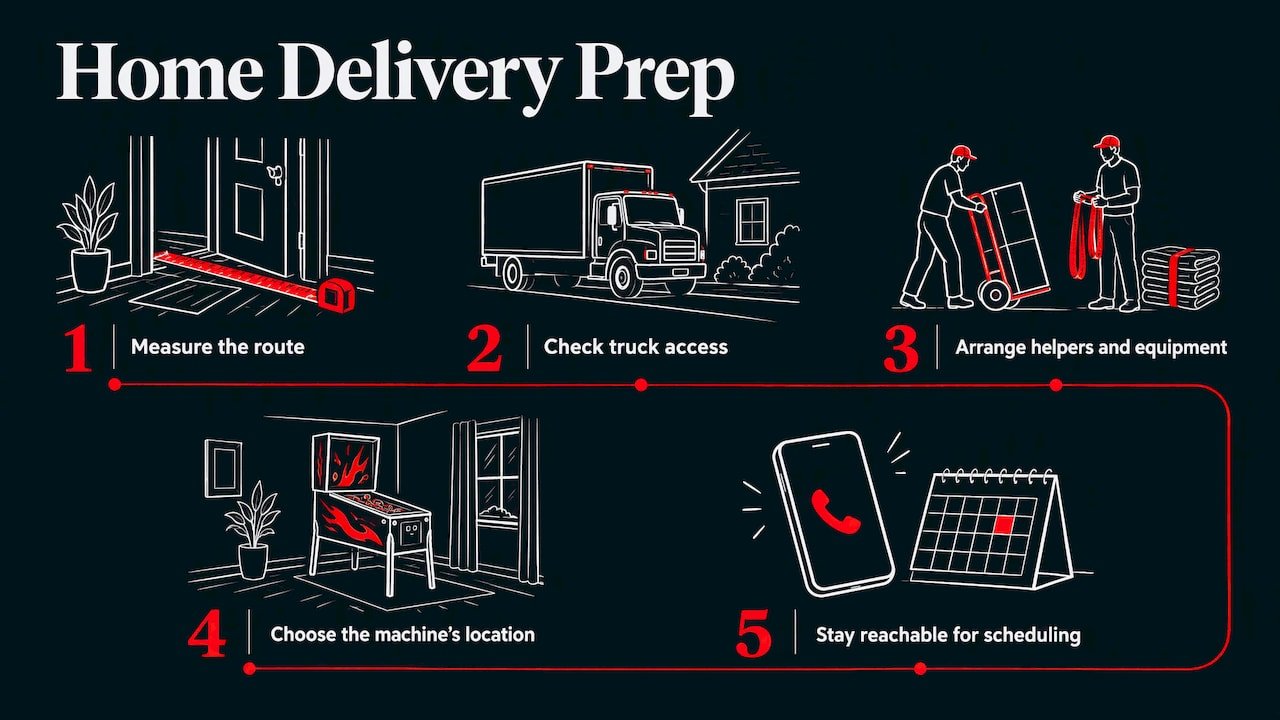
Measure the path
Measure the narrowest doorway or hallway on the route from the truck to the final spot, plus any turns and stair widths. Pinball cabinets are narrow once the head is folded and the legs are off, but they are long and heavy. Check the width of the cabinet in the machine’s specifications and compare.
Check the driveway and the curb
A full-size delivery truck needs room to stop and drop the liftgate. Low-hanging branches, steep slopes, soft gravel or a tight cul-de-sac can all prevent a truck from reaching your address. If that is possible, tell the seller or carrier up front so the delivery can be arranged properly.
Line up helpers and equipment
A machine that weighs 250 pounds or more should not be moved by one person. Bring at least two strong helpers, and consider a appliance dolly with straps. Clear the route of rugs, toys and anything that can catch a wheel.
Decide where it will live
A machine needs a level floor, a nearby grounded outlet and room to stand and play. Families should also leave space around the cabinet so children can reach the flippers without crowding. Businesses should think about foot traffic, the power supply and where the machine sits relative to other games.
Be reachable
Keep your phone nearby in the days before delivery. Freight carriers call to schedule, and a missed call can push the delivery back.
How machines are packed for the trip
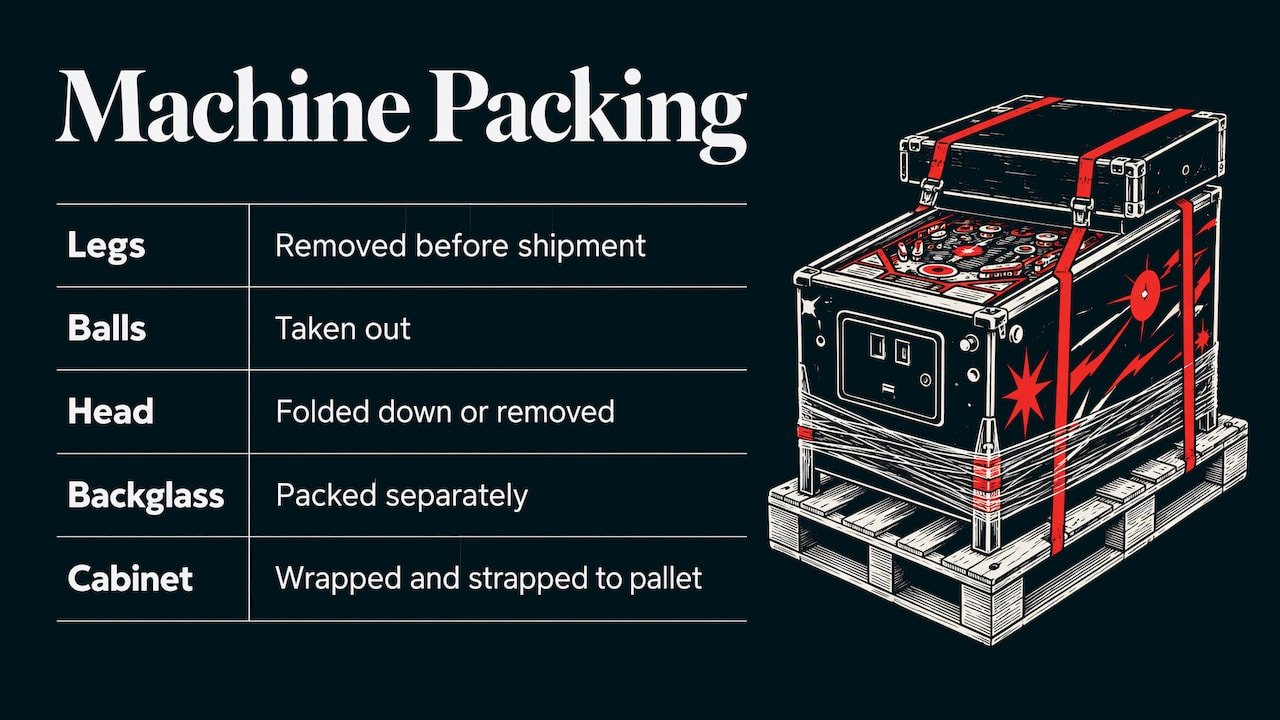
Knowing how a machine is packed helps you read the crate when it arrives. A properly prepared machine has the legs removed, the balls taken out, the head folded down or removed, the backglass packed separately, the cabinet wrapped and the whole thing strapped to a pallet. More detailed preparation includes removing the playfield glass, securing ramps and toys, locking or removing the tilt bob, and bagging the leg hardware.
The backglass deserves particular attention. It is the most fragile part of the machine and the most visible, which is why a damaged one is the thing buyers notice first. If you ever need one, our guide to pinball backglass replacement explains the options and fit.
The moment of delivery: inspect before you sign
This is the most important five minutes of the whole process. Once you sign, you have told the carrier the shipment arrived in good condition.
- Look at the outside first. Walk around the crate or wrapped pallet. Look for crushed corners, punctures, torn wrap, tilted stacking and water marks.
- Write it down. Any visible damage must be noted on the delivery receipt before you sign. Be specific: “corner of crate crushed, wrap torn near backbox” is better than “damaged”.
- Take photos. Photograph the crate from every side, the damage, and the driver’s paperwork before anything is moved.
- Do not refuse to sign out of fear, but do not sign blind. A signature with notes keeps your options open. A clean signature does not.
- Uncrate carefully and inspect before powering on. Check the cabinet, the backglass, the playfield and the legs. Do not plug it in until you have looked it over.
- Report hidden damage fast. If you find damage that was not visible outside, contact the seller and carrier right away and keep all packaging.
Why the notation matters: freight carrier liability is typically limited by freight class and the bill of lading terms, often far below a rare machine’s value, and a clean signature makes a concealed-damage claim much harder to win. For a collector buying a rare machine, make sure the shipment is declared at full replacement value or insured before it leaves.
Delivery questions by buyer type
Collectors
If you are buying a rare or restored machine, delivery is where its value is most at risk. Ask how it will be crated, whether the value is declared, and who handles a claim. Photograph the machine before it ships if you can, and again on arrival.
Families
For a home game room, the practical concerns are the route into the house and the floor. A basement or upstairs room changes the plan, because stairs are an access issue freight crews may not handle. Decide the room before you order, not after.
Business owners
A business address with a loading dock can often skip the liftgate and residential charges. A storefront without one is treated closer to a home. If you are building out a space, our guide to starting an arcade business covers costs, permits and game mix, and delivery planning belongs in that budget.
Perspective
Most delivery problems are not caused by the freight carrier alone. They come from a mismatch between what the buyer expected and what freight actually is. A pinball machine is a heavy, delicate object, and the buyer deserves to know that before checkout, not at the curb.
That is why we handle new and used machines as a dealer first and a shipper second. As an authorized dealer for Stern Pinball and Spooky Pinball, we work with machines straight from the manufacturers, and we offer nationwide delivery across the Lower 48 so a buyer anywhere can order with confidence. Our nationwide delivery page explains how it works and what to expect.
Our advice is simple. Choose a machine that fits your space, measure the path in, confirm access, and inspect at the door. Buying from a dealer who does this every day gives you one place to ask questions from the first click to the first game.
the author
Ready to order? Start with the machine
If you are planning a delivery, the machine comes first. We sell new and used pinball machines from major brands, official accessories, and a buy, sell and trade service, with nationwide delivery in the Lower 48. We also accept Bitcoin and cryptocurrency, and our financing guide lays out other ways to pay.

Browse the pinball machines in stock, look at Stern pinball machines if you want a new release, or see our American Pinball selection. Prefer a specific theme? The Jurassic Park Pro model by Stern and the Hot Wheels Deluxe by American Pinball are two to start with.
A delivery-day checklist
Print this or keep it on your phone.
- Door, hallway and stair widths measured and compared with the machine’s specifications.
- Truck access confirmed: curb space, overhead clearance, slope and surface.
- Two or more helpers and a dolly with straps ready.
- Final spot cleared, floor level, outlet nearby.
- Phone on and reachable for the scheduling call.
- Camera ready for photos of the crate and the paperwork.
- Pen ready to write damage notes on the receipt.
- Declared value or insurance confirmed with the seller before shipping.
- Time set aside to uncrate and inspect before plugging in.
Frequently asked questions
Can a pinball machine be delivered to a house?
Yes. Machines ship as palletized freight, and a liftgate lowers the pallet to the ground at a residence. Whether the driver brings it inside depends on the service you choose and on stairs, door widths and the driveway. We deliver nationwide across the Lower 48.
Why can’t a pinball machine ship by UPS or FedEx?
A full machine often weighs 250 pounds or more, above the 150-pound limit for UPS packages. That puts it in freight. Freight handles heavier pallets and quotes by weight, size and distance.
What should I do if the crate looks damaged on arrival?
Write the damage on the delivery receipt before signing, photograph everything and keep the packaging. Then uncrate and inspect before powering on. Contact the seller right away so the claim can start with the notes in hand.
Is residential delivery more expensive?
Often yes, because homes usually need a liftgate and may carry residential-delivery fees. Inside delivery costs more again. Our shipping cost guide explains what moves the price.