
The simplest way to sell a pinball machine is to start with a buyer who already deals in pinball and can handle the price, the payment and the move. That is what our buy, sell, trade service is for. Whatever route you pick, the same four jobs decide how well the sale goes: pricing the machine from real sales, getting it presentable, documenting it honestly, and handling payment and pickup safely. This guide walks through each one.
TL;DR
- Price from recorded sales of your exact title and condition, not from asking prices. A free sales database covers more than 13,550 recorded sales.
- Condition, completeness and buyer type move the price more than age does. The same game can sell for very different amounts.
- Clean it, test every feature, and photograph everything, including the flaws. Honest listings close faster and avoid disputes.
- Never ship or release the machine until payment has cleared, and keep the conversation and money on the platform you used.
- If you would rather trade in or sell outright, we run a buy, sell, trade service and deliver nationwide across the Lower 48.
Table of Contents
- Is there a market for used pinball machines?
- What your machine is worth
- Your options for selling
- Get the machine ready to sell
- Write the listing and take the photos
- Payment, pickup and moving the machine
- Common mistakes that cost sellers money
- Why trade rather than sell on your own
- Ready to sell or trade up?
- FAQ
- Sources
Is there a market for used pinball machines?
Yes, and a bigger one than most owners expect. A tally of used-machine sales by Kineticist counted 1,961 recorded sales in 2022 worth $10,567,154, an average of $5,389 per game. Because many sales are never recorded, it estimated the full used market at between $114 million and $172 million, with a 20% margin of error.
The same analysis lists where those machines change hands: enthusiast marketplaces (about 22% of the used market by its estimate), dealers, general classifieds, friends and family, local leagues, word of mouth, pinball shows and the occasional barn find. So demand is real. The question is which route fits your machine, your timeline and your patience.
What your machine is worth
Pinball pricing is not like pricing a used car, because there is no single book value. Two machines with the same title can sell for thousands of dollars apart. These are the factors that move the number:
- Cosmetic condition. Playfield wear, cabinet damage, faded backglass and yellowed plastics all matter. A clean, bright playfield is the biggest single visual factor.
- Mechanical condition. Does every flipper, bumper, ramp, magnet and display work? Machines that need repair are priced as projects.
- Completeness. Original topper, instruction card, keys, manuals and factory parts all add value. Missing parts subtract it.
- Title and era. Popular titles that collectors chase hold value. Others sell slowly at any price.
- Use history. A machine that lived in a home usually looks and plays better than one that spent years on a bar route.
- Buyer type. A serious collector hunting one specific title will usually pay more than someone who wants a quick flip.
- Mods and upgrades. Some add appeal for the right buyer. Others make a machine harder to sell.
Check sold prices, not asking prices
Asking prices tell you what hopeful sellers want. Sold prices tell you what buyers paid. Pinball Prices publishes a free guide built from verified sales and reports more than 13,550 recorded sales totaling $58 million across 1,510 titles, from 1932 through 2026. Search your exact title, then narrow to sales in a condition like yours.
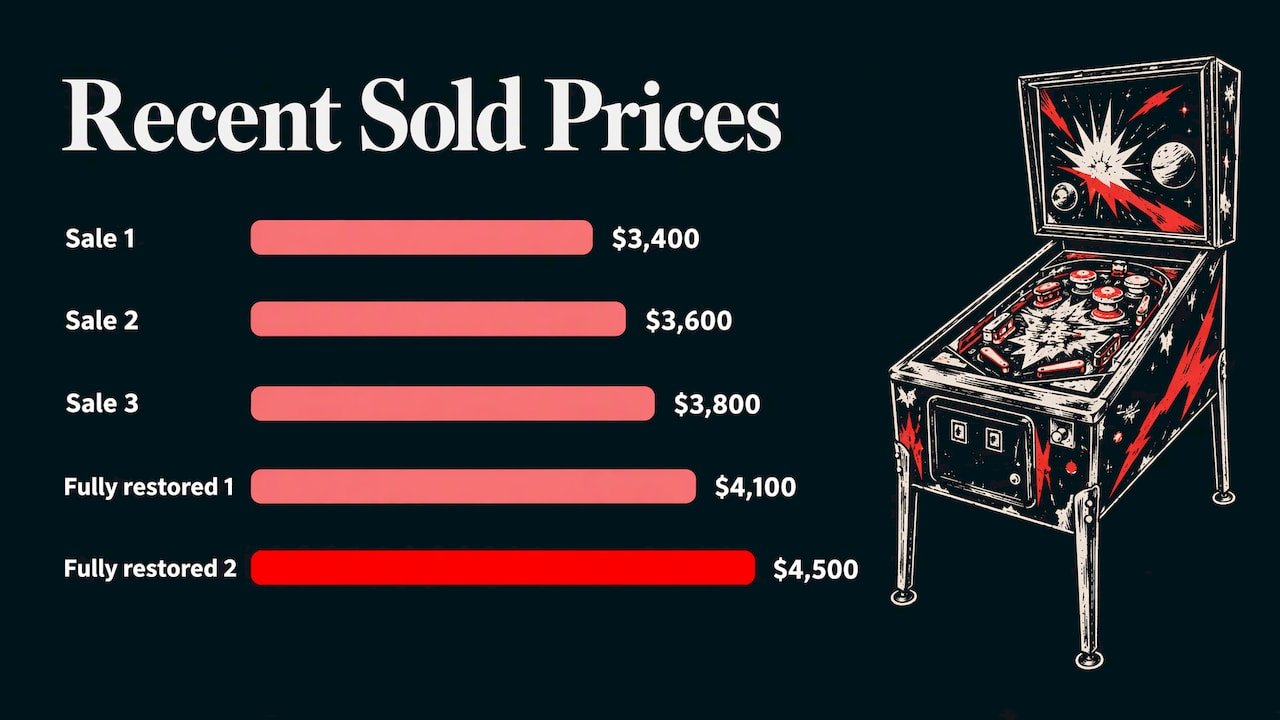
A worked example. Say you find five recent sales of your title at $3,400, $3,600, $3,800, $4,100 and $4,500. The top two went to machines described as fully restored. Yours plays well but has playfield wear and no topper. Your realistic target is in the lower half of that range, perhaps $3,400 to $3,800, and you would list near the top of that band to leave room for negotiation. This is the same logic a dealer uses, which is why a dealer’s offer and a private sale price are rarely the same number. The BBB’s selling advice says the same thing in plain terms: compare actual sale prices rather than guessing.
Price data moves as new sales are recorded, so treat any figure as a snapshot and check the live database the week you list.
Your options for selling
There are four types of route, and they trade price against speed and effort.
Sell or trade to a pinball dealer
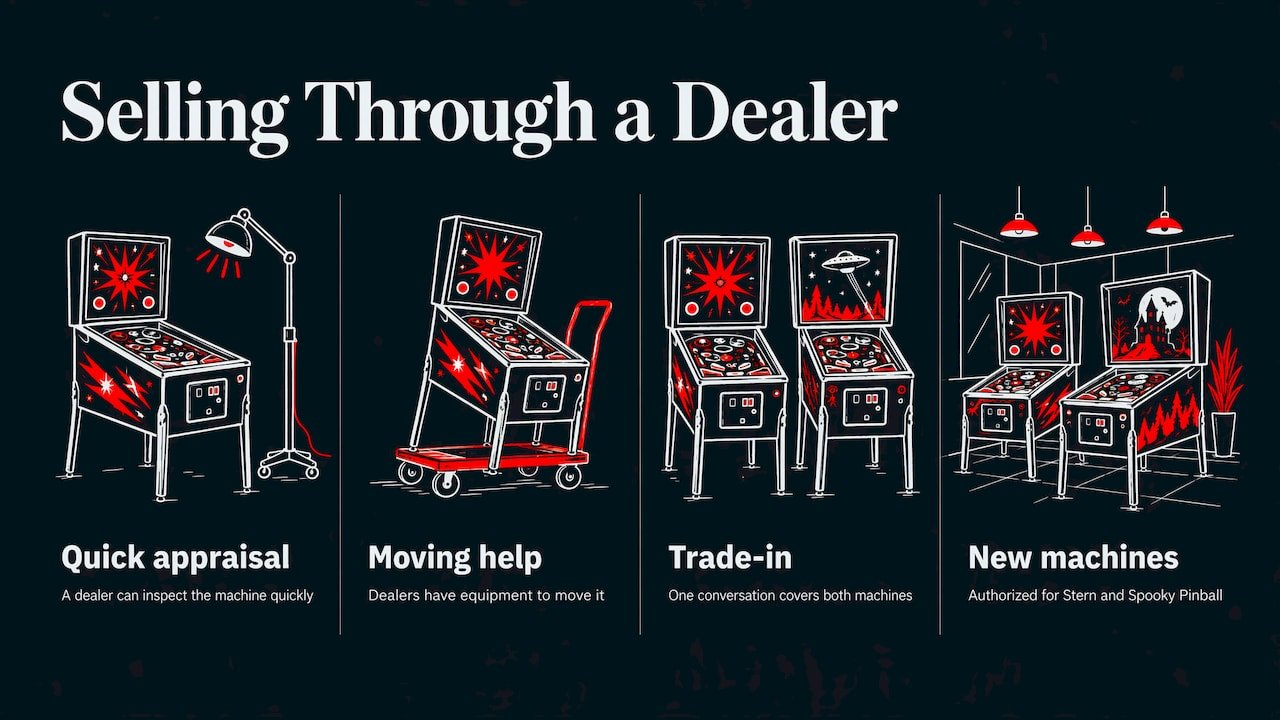
A dealer who buys and sells pinball every day knows what your title is worth, can inspect it quickly, and has the equipment to move it. You skip the stranger-in-your-garage problem, the endless messages and the buyers who vanish. If you want to put the money toward a newer machine, a trade-in is the cleanest path: one conversation covers both the machine leaving and the next one arriving.
This is what our buy, sell, trade service is built for. We are an authorized dealer for Stern Pinball and Spooky Pinball, and we sell new and used machines from major brands, so a trade can lead straight into something new from our pinball machine selection. Reach out through our site with your title, its condition and photos.
Enthusiast marketplaces and local groups
Specialist pinball marketplaces and local leagues put your machine in front of people who know exactly what they want. That can raise the price, but you do the work: write the listing, answer questions, screen buyers, schedule viewings and arrange the move. Expect it to take longer.
General classifieds
Local classified sites reach the most people, but they also bring the most low offers, no-shows and scam attempts. They suit common titles priced to move quickly, and only if you are comfortable meeting strangers.
Auctions
Auctions can work for rare machines with a following. You pay platform fees, and the final price depends on who is watching that week. Read the fee schedule and dispute policy before listing. The BBB advises sellers to understand platform fees and dispute policies up front.
Get the machine ready to sell
A machine that looks cared for sells faster and holds its price. You do not need a full restoration, but you do need to remove every reason for a buyer to knock the price down.
- Clean it properly. Wipe the cabinet, clean the glass, and clean the playfield with a cleaner made for pinball. Clean the rubber rings or replace the ones that are dried and cracked. Replace burned-out bulbs.
- Test everything. Run every game mode, switch, coil and display. Write down what works and what does not. A buyer who finds an unlisted fault at pickup will renegotiate or walk.
- Gather the extras. Find the keys, manuals, toppers, original parts and any receipts for repairs. Completeness is a pricing factor, so show it.
- Decide on repairs. Fix cheap problems such as a dead bulb or a weak flipper rubber. Leave expensive restorations to the buyer and price accordingly, since restoration costs rarely come back dollar for dollar.
- Secure loose items. Take out the balls, remove loose mods and lock the lockdown bar so nothing shifts during the move.
If you would rather not do any of this, a trade-in conversation with us starts from the machine as it is. Tell us its condition and send photos.
Write the listing and take the photos
A buyer cannot play your machine, so the listing has to do that job. Include:
- Exact title and manufacturer, with the year if you know it.
- Working status of each major feature, and a plain list of what is not working.
- Condition notes on the playfield, cabinet, backglass, plastics and legs.
- What is included: topper, keys, manual, mods.
- Where it is, whether it is on the ground floor, and whether stairs are involved.
- Your asking price and whether you will consider offers.
For photos, shoot the full front, both sides, the back, the backglass lit and unlit, the whole playfield, the close-ups of wear, and the serial number plate. Add a short video of the machine in attract mode and a few seconds of play. Date-stamped photos help in any later dispute, and shipping specialists such as Coin Machine Shippers recommend taking dated photos of all sides, the playfield and the backglass before pickup.
Disclose every flaw. The BBB tells sellers to disclose every flaw, and it protects you: a buyer who was told about the scratch cannot claim you hid it.
Payment, pickup and moving the machine
This is where most sales go wrong, because a pinball machine is heavy, awkward and expensive. Check our guide to pinball machine weight and how to move one before you promise to help a buyer load it.
Get paid safely
The BBB’s advice for selling online applies directly to high-value items like pinball machines:
- Do not ship until payment has cleared, not just until a notice arrives.
- Be wary of overpayment offers, fake payment notifications and anyone asking you for a verification code.
- Be cautious if a buyer pushes the conversation off the platform.
- For high-value shipments, use tracking and signature confirmation.
The BBB’s tips for selling used items online cover all of these. The Federal Trade Commission’s guide to online auctions for buyers and sellers adds that you should check the other party’s identity and reputation, avoid anyone who moves the deal off the auction site, and save descriptions, messages and transaction records.
Local pickup
When a buyer collects in person, the BBB suggests meeting in a busy public place where practical, bringing someone with you and limiting how much of your home address you share. A pinball machine rarely fits that advice, so stage it near a garage or front door and keep a second person on hand. If you cannot move it yourself, the BBB recommends hiring a mover rather than risking an injury.
Shipping
If the buyer lives far away, freight shipping is the norm. Learn what it costs before agreeing to anything. Our guide to pinball machine shipping cost explains what drives the price, and our page on nationwide pinball delivery explains how delivery works across the Lower 48. Before the carrier arrives, remove all balls from the trough and shooter lane, take off the topper and loose mods, lock the lockdown bar, seat the glass, fold or remove the head as the model requires, and have the coin door keys ready. The shipping company’s pickup checklist covers the same steps.
Common mistakes that cost sellers money
- Pricing from asking prices. Listings that sit unsold for months are not evidence of value.
- Hiding a fault. It comes out at pickup and the price drops anyway, or the buyer leaves.
- Releasing the machine early. A payment notice is not cleared funds.
- Selling the topper or keys separately by accident. List exactly what is included.
- Ignoring the move. Stairs, tight doorways and the machine’s weight cost people their sales and their backs.
- Waiting for a perfect buyer on a common title. Holding out for a collector price on a machine collectors do not want costs you months.
Why trade rather than sell on your own
A private sale can work, but it is a part-time job: pricing research, cleaning, photos, messages, scheduling, payment checks and the move. A trade or sale to a dealer compresses that into one conversation. If you are selling because you want a different machine, it also means the machine you are giving up and the one you are getting are handled together. For readers who want to trade up, our pinball machine financing guide explains how to pay for the next one.
Our view on selling a pinball machine
Most owners we would talk to are not really trying to sell a machine. They are trying to get into the next one, or to free the space and be done. That is why we built our shop around buying, selling and trading together, with new and used machines from major brands and delivery across the Lower 48.
Selling alone means you carry every step yourself, including the ones that go wrong: the unreliable buyer, the unclear payment, the heavy cabinet on the stairs. A dealer that is an authorized Stern Pinball and Spooky Pinball dealer sees these titles every day and can talk about your machine in the same terms a collector would.
We also accept Bitcoin and other cryptocurrency for purchases, so if your next machine is a bigger project, there is a payment route that fits how you already hold your money.
Start with the machine you have, tell us honestly what condition it is in, and we will take it from there.
the author
Ready to sell or trade up?
If you want to move your machine and pick up another, start with our buy, sell, trade service. Tell us the title, its condition and send photos, and look through our new and used pinball machines to see what you might trade toward. We deliver across the Lower 48 states.
If you are buying for a business rather than for the home, our guide to starting an arcade business covers costs, permits and game mix. Curious about the machines themselves? Our pinball history guide traces them from bagatelle to the present day.
FAQ
How do I sell my pinball machine?
Find recent sold prices for your exact title and condition, clean and test the machine, and photograph it in full. Then choose a route: a dealer trade or sale, an enthusiast marketplace, local classifieds or an auction. Confirm payment has cleared before it leaves your hands.
How much is my used pinball machine worth?
It depends on the title, condition, completeness and who is buying. Use a database of recorded sales, such as Pinball Prices, and compare machines in the same condition as yours. Expect a collector and a dealer to value the same machine differently.
Is there a market for old pinball machines?
Yes. Kineticist recorded 1,961 used sales in 2022 averaging $5,389 per game, and estimated the whole market is much larger because many sales go unrecorded. Demand is strongest for popular titles in good condition.
Can I trade in my pinball machine for another one?
Yes. Our buy, sell, trade service handles it. Send us the title, its condition and photos through our site, and we will talk through the machine you want next.
Sources
- Sizing the Used Pinball Market, Kineticist
- Pinball Prices price guide
- BBB tips for selling used items online
- FTC Internet Auction guide for buyers and sellers
- Pinball machine shipping checklist, Coin Machine Shippers